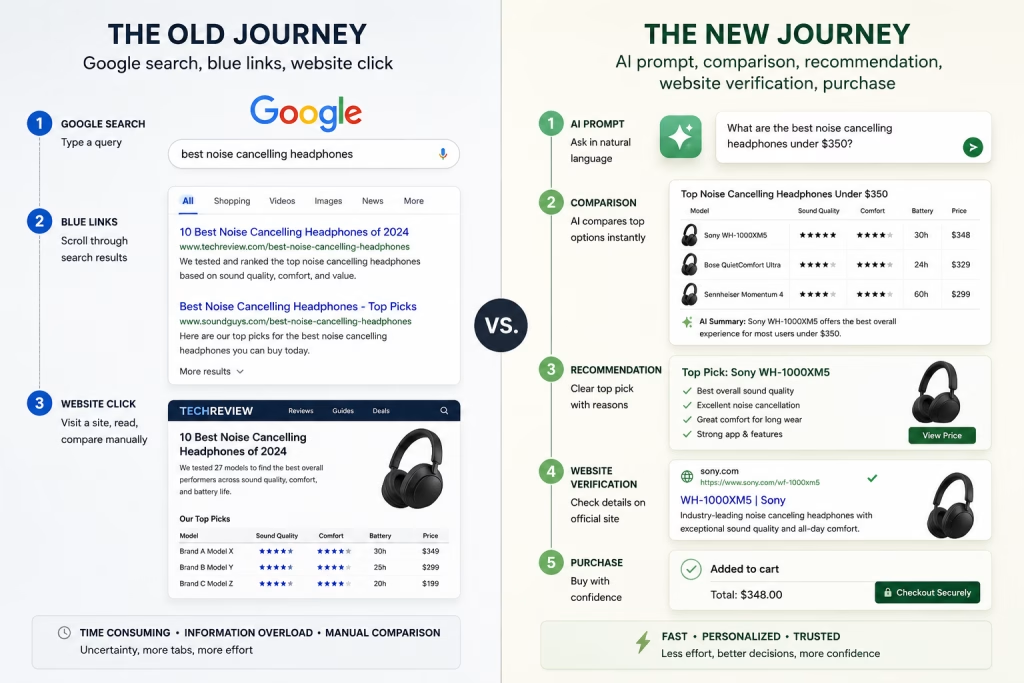
For years, online shopping search followed a familiar pattern. A customer typed a product or problem into Google, compared a list of results, opened a few websites, read reviews and made a decision.
That journey is changing.
Customers are still using Google, but they are also asking AI tools to help them choose. Instead of searching only for “best running shoes” or “WordPress hosting UK”, they might ask ChatGPT, Gemini, Perplexity or Google’s AI features to compare products, recommend suppliers, summarise reviews, find alternatives or explain which option is best for their needs.
This does not mean websites are becoming irrelevant. In fact, the opposite is true. A good website is still one of the most important sources of truth about a business, product or service. What has changed is how that website is discovered, interpreted and used.
From search results to AI recommendations
Traditional search asks users to do most of the work. Google gives a list of results, and the shopper compares pages, reviews, prices and product details themselves.
AI search changes that process. The user can ask a more detailed question, add constraints, explain preferences and ask for a shortlist. For example:
“What is the best coffee machine under £500 for a small kitchen?”
“Compare these three running shoes for someone with knee pain.”
“Which UK ecommerce agency can rebuild a WooCommerce store and provide ongoing support?”
“What should I check before buying from this online shop?”
OpenAI introduced shopping research in ChatGPT in November 2025, describing it as a way for users to describe what they are looking for and receive a buyer’s guide built from research across the internet. OpenAI also says hundreds of millions of people use ChatGPT to find, understand and compare products.
Google is also moving shopping search in this direction. Its AI Mode shopping experience uses Gemini with Google’s Shopping Graph to help shoppers browse for inspiration, narrow choices and compare products. Google says the Shopping Graph includes more than 50 billion product listings, with product details such as reviews, prices, colours and availability, and that more than 2 billion listings are refreshed every hour.
The direction is clear: online shopping search is becoming more conversational, more personalised and more comparison-led.
Is Google being replaced?
Not exactly.
It is more accurate to say that Google-only shopping journeys are being replaced by multi-source journeys. Google remains important, but users are increasingly mixing traditional search, AI search, social content, marketplaces, reviews, videos, forums, comparison sites and direct brand websites.
Google is also building AI deeper into Search itself. Its own Search Central guidance states that SEO is still relevant for generative AI features because Google’s AI experiences are rooted in core Search ranking and quality systems.
So the shift is not simply “Google versus AI”. It is that Google, ChatGPT and other platforms are all changing how information is found, summarised and presented.
For ecommerce businesses, this means the goal is no longer just to rank for a keyword. The goal is to be understood, trusted and selected across different discovery points.
Why websites still matter
There is a growing idea that if AI tools answer questions directly, businesses may not need websites as much. That is a risky assumption.
Websites still matter for five main reasons.
1. Your website is your source of truth
AI tools need reliable information to work from. Your website should clearly explain what you sell, who it is for, how it works, what it costs, where it is available and why someone should trust it.
If your product pages are thin, vague, outdated or poorly structured, AI systems may struggle to understand your offer accurately. Worse, they may rely on third-party sources that are incomplete, outdated or less favourable.
A strong website gives search engines, AI tools and customers a clearer source to interpret.
2. Product feeds and structured data depend on good website information
AI shopping tools are increasingly using product data, feeds, reviews, availability and pricing. OpenAI now has a merchant page encouraging retailers to share product feeds so their products can appear when shoppers explore options, compare products and decide what to buy. It also says merchants can send shoppers to their site or app by default.
That means websites and product catalogues are not disappearing. They are becoming part of a wider machine-readable shopping ecosystem.
For ecommerce businesses, this makes product data quality more important. Product names, descriptions, images, categories, prices, availability, variants, reviews and delivery details all need to be accurate and consistent.
3. AI can influence the decision before the click
In traditional SEO, a website often had to win the click before it could persuade the customer.
In AI search, the customer may form an opinion before visiting the site. The AI answer may summarise the brand, compare it with competitors, mention pros and cons, or recommend a specific product.
McKinsey reported in 2025 that half of consumers use AI-powered search, and that 44% of AI-powered search users said it was their primary and preferred source of insight. Its article also warned that brand-owned websites may make up only a small share of the sources referenced by AI search in some cases, with AI tools also drawing on publishers, affiliates and user-generated content.
This means your website still matters, but it cannot work alone. Your product information, reviews, third-party mentions, guides, comparison content and reputation all contribute to how AI tools may describe you.
4. The website is still where trust is checked
AI can help shortlist options, but many shoppers still want to verify the business before buying.
They may check:
- Does the website look credible?
- Are product details clear?
- Are reviews visible?
- Are delivery and returns policies easy to find?
- Is there a real address or contact information?
- Are prices, stock and shipping information consistent?
- Does the business explain who it is?
This is especially important because AI shopping recommendations are not perfect. AI systems can still surface incomplete, outdated or unreliable sources. For customers, the website remains a key trust checkpoint before purchase.
5. The website is still where conversion happens
AI tools may influence discovery, but for most businesses the website remains the place where enquiries, purchases, bookings, quote requests or subscriptions happen.
Google is testing new AI-powered Shopping ads and conversational ad formats, but these are still designed to connect consumers with advertisers, products and offers.
For most businesses, the website remains the commercial hub. It is where you control the product experience, checkout, forms, content, upsells, tracking, support information and brand presentation.
What ecommerce websites need to change
The old approach to ecommerce SEO was often built around category keywords, product names and technical fixes.
Those still matter. But AI search adds new requirements.
Product pages need to answer real buying questions
A product page should not only say what the product is. It should help someone decide whether it is right for them.
Useful sections include:
- Who is this product best for?
- What problem does it solve?
- What are the key specifications?
- What should buyers compare it with?
- What is included?
- What are the delivery and return details?
- What do reviews say?
- What are the common objections?
- What alternatives are available?
This helps humans, search engines and AI tools understand the product more clearly.
Category pages need more decision support
Many ecommerce category pages are still just product grids with a short paragraph of SEO copy.
In an AI search world, category pages should act more like buying guides. They should explain the differences between product types, key features, use cases, price points and suitability.
For example, a category page for office chairs could include:
- Best office chairs for home working
- Mesh versus fabric office chairs
- What to look for if you have back pain
- Chair sizes and adjustability
- Delivery and assembly information
- Links to bestsellers and reviews
This gives AI systems richer information to draw from and gives customers more confidence before buying.
Reviews and third-party proof matter more
AI tools often summarise what other sources say. That means reviews, product ratings, independent mentions, comparison sites, expert guides, social proof and marketplace data can all influence how a business is represented.
For ecommerce brands, this means reputation should not sit separately from SEO. Review generation, product ratings, customer photos, case studies, expert content and trusted third-party profiles all support visibility.
Content needs to match comparison-style searches
AI shopping behaviour is often comparison-led. Customers are not only asking “where can I buy this?” They are asking:
- Which product is best for my situation?
- Is this worth the price?
- How does this compare with another product?
- What are the drawbacks?
- What should I avoid?
- Which brand is most trusted?
- What do customers complain about?
Websites that answer those questions clearly are more useful in both traditional search and AI search.
So, are websites becoming less important?
No. But their role is changing.
The website is no longer only the destination after a search result click. It is also:
- a source for AI answers
- a trust signal
- a product data hub
- a conversion platform
- a proof library
- a place to answer buying questions
- a reference point for third-party platforms
A weak website will struggle in both traditional SEO and AI search. A strong website gives AI systems clearer information to interpret and gives customers more confidence when they arrive.
How to prepare your ecommerce website for AI search
The practical steps are not about chasing shortcuts. They are about making your website clearer, more useful and better structured.
Start with these priorities:
- Improve product data
Make product names, descriptions, prices, variants, availability and images accurate and consistent. - Add answer-led product content
Include short sections that answer common buying questions. - Strengthen category pages
Turn important categories into helpful buying guides, not just product listings. - Use structured data
Mark up products, reviews, breadcrumbs, FAQs and organisation details where appropriate. - Improve internal linking
Link between products, categories, guides, comparisons and support pages. - Build trust signals
Show reviews, returns information, delivery details, contact information and company credibility. - Review third-party visibility
Check how your products and brand appear on marketplaces, review sites, directories, comparison sites and AI-generated answers. - Track AI-style prompts
Regularly test the questions customers might ask AI tools and record whether your brand, products or competitors appear.
Final thought
The future of online shopping search is not about choosing between Google, AI tools and websites. Customers will use all of them.
The businesses that adapt best will be the ones that make their products easy to understand, compare, trust and buy across every touchpoint.
Websites are still important. But they need to work harder as structured, trustworthy, answer-led sources for both people and AI systems.
Checkout our Technical SEO page for more information. See how we can help redesign your new website.
Is AI replacing Google for online shopping?
AI is not fully replacing Google, but it is changing the shopping journey. Customers now use a mix of Google, AI tools, marketplaces, reviews, social platforms and brand websites to research and compare products.
Do ecommerce websites still matter in AI search?
Yes. Ecommerce websites remain important because they provide product information, trust signals, structured data, checkout journeys and source material that search engines and AI tools can interpret.
What is AI shopping search?
AI shopping search is when customers use tools such as ChatGPT, Gemini, Perplexity or Google’s AI features to find, compare and evaluate products through conversational questions rather than simple keyword searches.
How can ecommerce websites prepare for AI search?
Ecommerce websites should improve product data, add answer-led content, strengthen category pages, use structured data, build trust signals and review how their products appear across third-party sources.