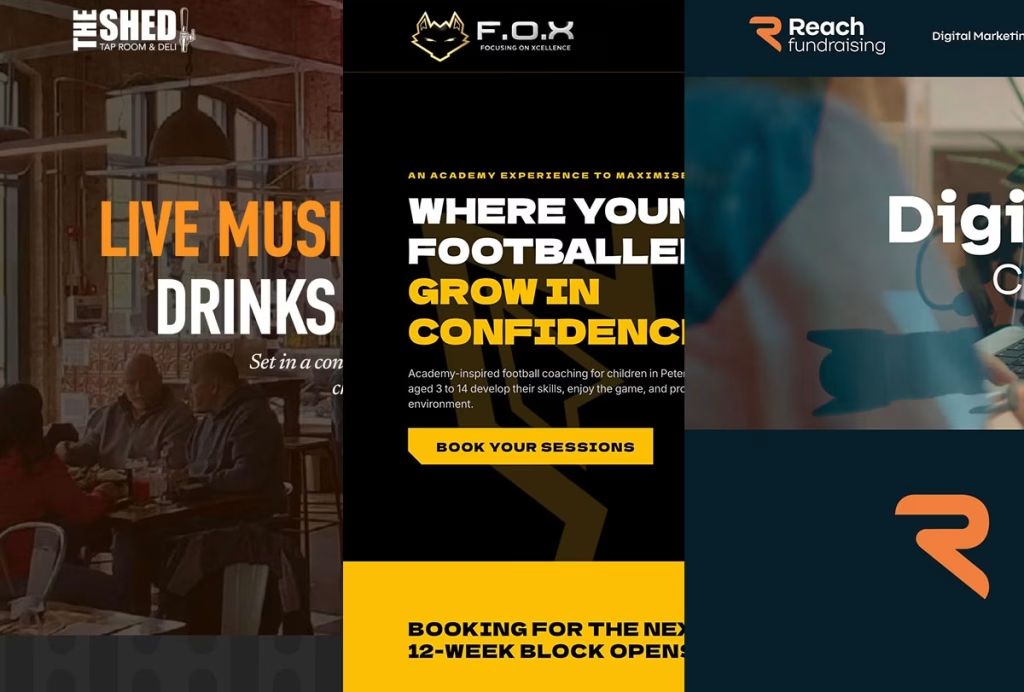
A good website should do more than look polished. For most Peterborough businesses, it needs to explain the offer quickly, help visitors find the right information, build trust and make the next step obvious.
That next step might be booking a table, enquiring about a coaching session, reading about a service, or contacting the team. The exact goal changes from business to business, but the principles behind effective website design are often similar.
Looking at three different Peterborough-linked projects – The Shed, F.O.X Focusing on Xcellence and Reach Fundraising – shows how website structure, messaging and user journeys can make a real difference.
1. Make the purpose of the website clear immediately
Visitors should understand where they are and what they can do next within the first few seconds.
For The Shed, the website needed to present a taproom and deli in Peterborough as a destination, not just a place with basic contact details. The venue is set in a converted railway engine shed and combines food, drink, live music, comedy and group bookings, so the website had to communicate character while still making practical actions easy.
That is a useful lesson for any local business. Your homepage should not rely on visitors working everything out for themselves. It should quickly answer:
- What do you offer?
- Who is it for?
- Why should someone choose you?
- What should they do next?
For a restaurant, that might mean viewing the menu or booking a table. For a service business, it might mean requesting a quote. For a charity or consultancy, it might mean understanding the services before making an enquiry.
2. Structure the website around real customer journeys
A website should be organised around how people actually make decisions.
The Shed project needed to support different visitor intentions, including food and drink, live events, group bookings and general venue information. The navigation was structured around those real-world journeys, with areas such as what’s on, food and drink, live music and comedy, group bookings and contact.
This is where many local websites become harder to use than they need to be. They are often structured around internal business thinking rather than customer intent.
A stronger approach is to plan pages around the reasons people visit the site. For example:
- I want to book
- I want to compare services
- I want to check whether this business works locally
- I want to see proof before I enquire
- I want to understand what happens next
This makes the website easier to use and also gives search engines a clearer understanding of what each page is about.
3. Use local detail where it genuinely helps
Local detail should not be added as filler. It should help the visitor.
For F.O.X Focusing on Xcellence, local information mattered because parents needed to understand the coaching offer, the age groups, the session types, the venues and how to book. The case study explains that F.O.X provides academy-inspired football coaching in Peterborough for children aged 3 to 14, with services including weekly sessions, tournaments, camps, birthday packages, a grassroots club pathway and online booking.
That local information is useful because it supports both trust and action. Parents can quickly see whether the sessions are relevant, where they happen and what the next step is.
For other Peterborough businesses, useful local detail might include:
- Areas served
- Local meeting options
- Delivery locations
- Venue or office information
- Sector experience in Peterborough
- Reviews from nearby customers
The key is to make local content practical, not decorative.
4. Build trust before asking for the enquiry
People rarely enquire just because a website looks modern. They enquire when the site gives them enough confidence to act.
For F.O.X, the website needed to create a clear journey for parents, communicate trust and quality quickly, and make it easy for visitors to understand which sessions were right for their child. The finished website supported that with clear service sections, booking calls to action and practical local information, including Peterborough venue details.
This applies across many local sectors. A Peterborough business website should include proof close to the decision point, not hidden at the bottom of the page.
Useful trust signals include:
- Relevant case studies
- Short testimonials
- Years of experience
- Team or founder information
- Clear process details
- Accreditations or memberships
- Specific examples of previous work
- Local address or meeting information
A trust signal is strongest when it connects directly to the visitor’s concern. If they are worried about reliability, show support and process. If they are worried about quality, show examples. If they are worried about choosing a local supplier, show local work and local availability.
5. Treat content structure as part of web design
Good web design is not just visual. The way content is grouped, labelled and prioritised has a major effect on how useful the website becomes. Your chosen Peterborough web design agency should know this.
Reach Fundraising needed a new website following a rebrand, with the aim of clearly communicating digital marketing services to the charity sector, strengthening credibility and improving organic visibility through a more SEO-led structure. The project included clearer service organisation, navigation that helped users find relevant information, and SEO requirements built into the page structure without making the content feel unnatural.
This is a valuable lesson for service-led businesses in Peterborough. A website can look professional but still underperform if the service structure is unclear.
Before writing or designing a page, ask:
- Which search intent does this page support?
- What question is the visitor trying to answer?
- What proof do they need before they trust us?
- What action should they take after reading?
- Clear process details
- What other page should they visit next?
When the answers are clear, the website becomes easier to design, easier to write and easier for visitors to use.
6. Give every important page a clear next step
Every key page should guide the visitor towards a useful action.
For The Shed, booking was treated as a primary conversion action, with direct booking links and prompts for planned occasions. For F.O.X, booking calls to action helped move parents from interest to action. For Reach Fundraising, the structure helped users understand services and continue into the relevant areas of the site.
For a Peterborough business website, the next step might be:
- Book a call
- Request a quote
- View a case study
- Download a guide
- Book a table
- Submit an enquiry
- View services
- Check availability
A common mistake is using the same call to action everywhere. It is usually better to match the action to the page. A service page might invite an enquiry. A case study might send users to a related service. A blog post might guide users to a landing page or a free health check.
7. Use case studies to support local search visibility
Case studies are valuable because they provide specific, local evidence. They show what was needed, what was delivered and why it mattered.
For a business trying to improve visibility for searches such as web design Peterborough, case-led articles can support the main landing page by showing real examples of local website design work. The main landing page should remain the primary commercial page, while blog posts and case studies provide supporting context.
A good structure is:
- Main landing page: Web design Peterborough
- Supporting article: What Peterborough businesses can learn from three local website projects
- Individual proof: The Shed, F.O.X and Reach Fundraising case studies
This gives visitors and search engines a clearer content cluster. It also makes the site more useful because someone can move from broad advice to specific examples, then into the service page when they are ready.
What this means for Peterborough businesses planning a website
A successful website project should start with the business goal, not the page builder.
The Shed needed a website that promoted the venue, events and bookings. F.O.X needed a professional platform that made coaching options clear for parents. Reach Fundraising needed a more structured, SEO-led website to explain services and improve visibility. Each project had a different audience, but each relied on clear structure, focused messaging and a practical user journey.
For Peterborough businesses planning a new website or redesign, the most useful questions are:
- What do visitors need to understand first?
- Which services or offers need their own pages?
- Where does local proof matter?
- How should users move from interest to action?
- What should the website support after launch?
Planning a website project in Peterborough?
If you are reviewing your current website or planning a new WordPress build, our web design for Peterborough businesses service explains how we approach structure, design, WordPress development, SEO foundations and support after launch.
You can also explore the full case studies for The Shed, F.O.X Focusing on Xcellence and Reach Fundraising to see how different local and service-led projects were planned.